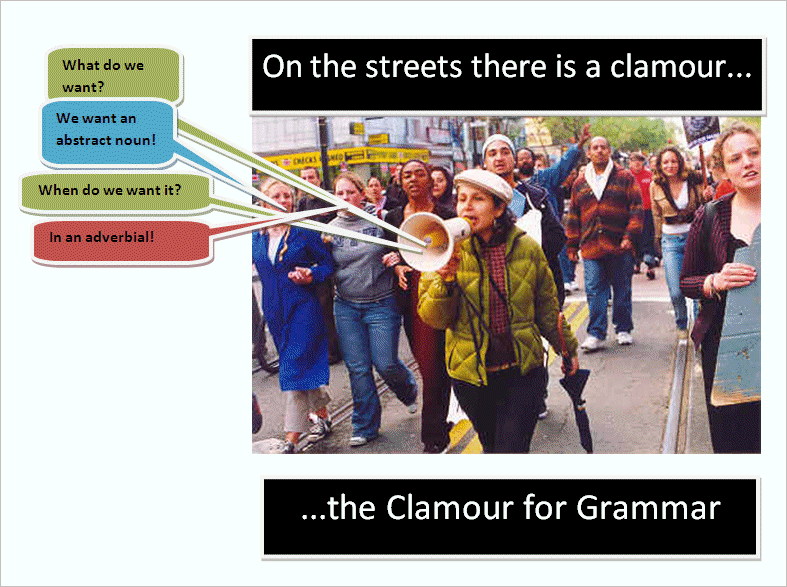
Thanks to everyone who came to our Glamour of Grammar day last week. We thought it was a good start to our work with teachers and it has given us plenty of ideas for what to cover in future events.
In the first session Bas Aarts introduced the day and kicked off with some discussion about the place of grammar in secondary English teaching. He looked at how grammar was sidelined in the late 1960s, with more of an emphasis on students' own personal responses to language and literature coming to the fore, before undergoing something of a revival with the National Strategies in the last decade. Grammar is worthy of study in its own right, he argued, but even more interesting when looked at as part of a wider problem-solving strategy which encourages young people to think for themselves, develop argumentation skills and relate what they understand to the language they see around them.
The second session, presented by Dan Clayton, took a look at three different resources that introduced grammar to different age groups. In the first resource he looked at how a made up language could be used to explore concepts in English grammar such as morphology, tense and syntax with Key Stage 3-4 students. Using spoken language as a starting point for the second resource, he then looked at how to relate grammar to context, considering factors such as the time between presentation and representation in texts such as sports commentaries and match reports. In a third and final resource, Dan looked at how ideas about form and function might be explored using the ICE-GB corpus and a search for tag questions in male and female language.
Barbara Bleiman from the English and Media Centre ran the third session and used extracts from their new spoken language resource to talk about approaches to the structure and form of spoken language with special reference to the new spoken language study at GCSE.
In the final session, delegates got the chance to test out the ICECUP tool to search the corpus and find out a bit more about how to use a corpus in investigating language. Sean Wallis explained some of the capabilities of the software and the potential uses of the corpus in the classroom while Bas Aarts gave an overview of the types of texts in teh corpus and how to carry out basic searches.