Monday, November 28, 2011

A Marriage Made in Hell

It was telling that in his speech at Cambridge University last week the Education Secretary, Michael Gove referred first to Classical scholars then to Victorian politicians before finally turning to Wagner, because it's by using these waypoints that he expects us to find our way to the sunny uplands of educational success. Why? Because he likes them. That's why.

So we're likely to get a soundtrack of the Ride of the Valkyries as Gove guns his ARK academy-sponsored helicopter upstream, Air Marshal Sir Simon Heffer his trusty reargunner, blowing holes in the post-modernist arguments of the cultural relativists with his rockets of truth.

While Gove's obvious passion for education is evident - which, let's face it, really should be the minimum entry requirement for the job - his approach is worrying. I could go on at length about why he's wrong about so many things in his speech, but I'll confine myself to his points about English teaching here.

Conventional grammar - as we understand it here and as Simon Heffer lays it out masterfully in his wonderful book Strictly English - doesn’t feature in the English curriculum.

But the English Language GCSE can include listening to tape recordings of Eddie Izzard and the Hairy Bikers.

What is he talking about? Grammar is taught in schools, going right back to Key Stage 1. My own children have been coming home from school with worksheets on causal connectives, adverbs and adjectives for a good few years now. Isn't Gove aware of what is taught in primary schools?

He might have had a point had he limited himself to arguing about a lack of grammar teaching in secondary English, but instead he makes a cheap point about the texts used in spoken language study at GCSE by namechecking Eddie Izzard and the Hairy Bikers. The point of analysing spoken language at GCSE is that it's often being looked at exactly for its structure and its grammar. Just because the choice of texts is contemporary or controversial (as the Telegraph tried to suggest in this feeble attempt to engineer a scandal) doesn't mean that the analysis of them is any less rigorous. Have a look at the excellent resources on spoken language from the English and Media Centre or All Talk, or the demanding work on spoken language and mode covered in AQA A's Language and Mode paper to see what this sort of study really involves.

Secondly, Simon Heffer's book is hardly "wonderful". We've described it as "cobblers" on here before, the linguist, Geoff Pullum was moved (in his THE review) to say "Heffer should be ashamed of himself, and Random House should be ashamed of this book", while David Crystal reviewed it for The New Statesman and commented "...there is no logic behind his recommendations, other than the usual kind favoured by pedants: if I like it, it's logical; if I don't, it isn't".

If Gove is taking grammar lessons from Heffer, we're likely to be disappearing into our Victorian fundaments very soon, while churning out a generation of chaps who know how to address a Baronet.

Surely, the real questions to ask here are "What do we want young people to learn when they study English language?" and "How do we help make that happen?", not "What did I like about English and how do I get everyone else to do the same thing?".

As far as grammar teaching goes, as we've looked at on here several times, the jury is still out over whether teaching "conventional grammar" is actually any good for students of English. Virtually every research paper into grammar teaching has shown that there is either no impact or indeed a negative impact on students' writing skills after being taught conventional grammar. That kind of grammar teaching has failed before and will fail again.

It's not because of some limp-wristed liberalism that English students aren't parsing sentences or writing dictations every waking moment; it's more a result of pragmatism and frustration. If we're going to teach grammar in schools - and obviously our project is all about that, so we think it is worthwhile - we have to look at what works and what will actually create the kinds of engaged understanding of language that will allow students to progress.

Work like that at Exeter Univeristy, pioneered by Debbie Myhill, work like that of the English and Media Centre, work by A level English Language teachers all over the country every day is what we should be using as an inspiration, not the antiquated ramblings of a man who says that "grammar is not a subject for debate" or the words of an Education Secretary who attacks the Arctic Monkeys before using Jade Goody as a model for educational self-improvement.

Friday, September 30, 2011

Survey wins UCL Enterprise Award

We’re delighted that the Survey has been awarded a UCL Enterprise Award for a project entitled Marketing the resources of the Survey of English Usage by the BEAMS Knowledge Transfer and Enterprise Board and the Vice-Provost (Enterprise). The project’s aims are to commercialise the AHRC-funded Web-based platform for English Language Teaching and Learning.

Friday, September 2, 2011

iGE - the interactive Grammar of English

Colleagues at the Survey of English Usage at UCL have just released this excellent app for the iPhone 3 and 4, iPod Touch and iPad. It's available as a free lite version, or you can pay £4.99 to download the full version.

Part of the Teaching English Grammar in Schools project has involved developing interactive quizzes and tests to help consolidate students' and teachers' grasp of grammatical concepts and frameworks, and the iGE app is a nifty way of doing that. Obviously, we're biased, but we think it's great.

Thursday, August 25, 2011

Grammer Matters

With today being GCSE results day, it's traditional for newspapers like the Daily Mail and Telegraph to denigrate the grades students have received and rubbish their qualifications. But this year it's different. It's not just that GCSE grades are over-inflated: the whole qualification is dreadful and schools aren't "fit for purpose".  So the Telegraph seems to be saying something like "Congratulations GCSE students on your excellent crop of grades! Well done for all your hard work and that of your teachers too! Now, come closer, so I can whisper this to you: your qualifications are worthless". Nice.

However, in their rush to prescribe solutions for poor levels of literacy and numeracy - a favoured solution to the former being penalising poor spelling and grammar in all GCSE exams - the Daily Telegraph rather put its foot in it. See if you can spot the not so deliberate mistake in this headline:

the original headline - changed later in the day to remove the apostrophe error

And the chorus of abuse from Telegraph readers directed at GCSE students and their teachers was little better. One correspondent decided it was all the fault of patios. Yes, patios.


But cheap digs aside, the more serious point here is that grammar is once again a battlefield, not because it's necessarily on the frontline of any great linguistics war, but because it's often used as an index for wider social issues, be they standards of education, attitudes to authority or even immigration and single-parent families.

In his now infamous Newsnight rant, the historian David Starkey made a link between language and criminality, a link that has never been far away from the surface of some debates about language use (as I've pointed out here on the SFX blog) and one which shows that for many prescriptivists bad grammar is just a few steps away from riots on the streets.

Thursday, April 28, 2011

The appliance of science

Thanks to Lesley Moss for this link to an article in the Daily Mail about the benefits of educational apps for primary pupils.

Friday, March 4, 2011

To happily potter

Simon Hoggart's column in Friday's Guardian featured a mention of Bas Aarts' new Oxford Modern English Grammar (available now from all good retailers). Hoggart expressed delight that a grammarian wasn't slavishly following old-fashioned prescriptive judgements about split infinitives, allowing him to feel unashamed of saying "I'm going to happily potter about in the garden". We've always said that grammar is good for you but it can also make you happy.

Slightly less prestigiously, Dan had his letter about Rastamouse and grammar printed in the Evening Standard this week, which he was very excited about, even if no one else was (even his own kids, all avid viewers of the mighty mouse). Because it's not online, I'll reproduce it in all its brief glory here:

It's a pity that Rastamouse has been criticised by some for encouraging "sloppy" English. There's nothing sloppy about different varieties of English and in fact most of them have very logical and well-established systems of grammar in place.

Rastamouse could actually be a very effective way of helping young people learn more about not only Jamaican English but also Standard English and the different forms of grammar used in other dialects. There's a growing body of linguistic evidence that analysing the grammar and vocabulary of non-standard varieties really helps young people start to understand the patterns we all use in our speech and writing. And that has to be irie.

Wednesday, March 2, 2011

National Grammar Day

It's National Grammar Day in the USA on March 4th, and this webpage has lots more information about how it is being celebrated. Among my favourites are the Correct the Celebrity classroom task in which you spot the grammatical errors in Justin Timberlake lyrics, Paris Hilton's blogs and various film titles, although I'm saddened by the fact that we can't just put a big red ring around Paris Hilton herself and fail her.

There are some good tips on writing clearly, some myths exploded about "bad" grammar, and overall it's good clean fun. It veers a little towards the prescriptive for my tastes (Why's there no discussion about dialect forms, for example?), but you can't win 'em all.

Monday, February 28, 2011

NATE conference

We presented a workshop at this year's NATE (National Association for the Teaching of English) conference which was hosted at the British Library from last Thursday until yesterday. Thanks to anyone reading this who was there. We hope it gave you some ideas about where our project is heading and how we can integrate grammar teaching more effectively in our teaching of the subject through Key Stages 3 and 4 and into A level.

The link for the Survey Monkey feedback questionnaire is here and we will get in touch with respondents as soon as we can,along with those of you who gave us email addressses at the event.

Friday, February 11, 2011

What Rastamouse can tell us about grammar

The new Cbeebies series Rastamouse has been attracting favourable attention for its gentle pace, top soundtrack, likeable characters and, above all, its use of Jamaican English throughout. In fact, it's probably about time the Daily Mail launched a campaign to bring it off our screens for corrupting the nation's youth with its crazy creole.

As well as being fun to watch (and I was watching with my 6 year-old daughter, so it's not as tragic as it sounds) it's a mine of linguistic interest for anyone looking at non-standard grammar. One of the themes that we focused on in this previous post was that the spread of different varieties into the English language mainstream shouldn't be seen as a problem, but an opportunity to look at both the non-standard variety and the standard itself. Rastamouse and Da Easy Crew's use of non-standard grammar can therefore be a great chance to look at areas like subject verb agreement, pronouns and case, elliptical forms, tense formation and pluralisation. Of course, it's also interesting in terms of phonology and lexis, but we'll save them for now.

In episode 6, Hot Hot Hot, for example, Scratchy tells Zoomer "Ya skip a beat" using an uninflected verb skip to signify the past tense (skipped), while Rastamouse says "Mi just not feelin' it today", using the 1st person object pronoun, me, rather than the standard I. In this construction there's also ellipsis of the auxiliary verb in the present progressive construction (mi just not feeling it today, rather than I am just not feeling it today), another typical feature of Jamaican English.

And there's plenty more. Of course, the danger of looking at all of this as a comparison between a standard form and a variety is that a deficit model is applied i.e. that all variations are seen as away from a norm and that the variations are therefore somehow inferior. One way to avoid this - and I can't claim this is foolproof by any stretch - is to highlight the fact that these aren't just arbitrary deviations from a norm, but part of a pattern. The Jamaican English has a very logical system to it and the "rules" are applied consistently to the grammar.

Linguists such as Mark Sebba and Roger Hewitt have looked very closely at varieties of English such as this and charted their influence on the language of English speakers, so if you're looking at creoles for A level  English Language or just want to find some interesting resources on language variation, there's plenty to explore.

Now all I need to do is stop watching the episodes on the Cbeebies website and get to work on some resources that use clips from the show. Then all will be irie.

edited to clear up naming confusion

Thursday, February 10, 2011

Fight fight fight

This article by Jamie Keddie from One Stop English is a really neat way of getting students to have fun while exploring language. It uses the Google Fight website to test out the frequency of different usages on the internet, so shows you, for example, which out of different to or different from would get more hits ("different from" wins with 27,800,000 hits, compared to 769,000 for "different to", by the way).

While the website is good clean fun, James Keddie's article puts it all in context and explains its use in the classroom, along with some of its potential pitfalls. But of course, every pitfall is just another way of asking students a few more questions about language, so they can be helpful in formulating clearer ideas about how to do research.

Tuesday, February 8, 2011

Language Wars

There has been some interesting media coverage of a new book by the Evening Standard journalist Henry Hitchings, Language Wars. Hitchings has previously written a fair bit about language, with his book on Johnson's dictionary and The Secret Life of Words both coming recommended.

Language Wars takes on the prescriptive mindset that change is bad and lays into the self-appointed rule-makers of English. It's not a new position, but it's one argued with a lot of passion if the trailers I've read so far are anything to go by, and I'm looking forward to reading the whole book later this week. The book has been reviewed in several places already. The Evening Standard liked it (obviously) but the reviewer seemed a little taken aback at Hitchings' vehemence. The Daily Telegraph, spiritual and actual home of arch-pedant Simon Heffer (predictably) slated Hitchings' stance on "rules".

In an Evening Standard article a week ago, Hitchings picked the changing nature of London English as a good example of how we should accept and embrace language change.

While it's language in general, rather than just specifically grammar, that Hitchings looks at in his article and in much of his book, it's difficult to separate the two. Throughout history, most people's ideas about language have been intertwined with their feelings about the "correctness" or otherwise of what they write and say, and grammar has always had a huge - often negative - role in this. Many of those who have assembled the "rules" have offered grammatical guidance that is often dubious in its nature. Many of the "rules" have been poorly explained or just designed to mark out one section of society as correct and the rest inferior in their usage, so it's no great surprise that to many people grammar is a word full of negative connotations.

Friday, November 12, 2010

The Clamour for Grammar - thank you

Thanks very much to everyone who came to our Clamour For Grammar day on Wednesday. It was a small, specially-selected - some might say "elite" - group of teachers and advisers who came along for the day and we were really pleased to meet you. We've already had some very positive feedback and are thinking ahead to similar days next term and/or in the summer. If you are interested in coming along to another grammar day (Grammar Hammer, perhaps?) or have specific ideas for what you would like covering in future sessions, please let us know by emailing Dan on the address on this page. We're also interested to find out the best time of year to organise such days.

Thanks too to Seth Mehl for his help on the day.

Friday, November 5, 2010

Spreading the word

We've been trying to raise the profile of grammar teaching and the ideas involved in our project by talking to various other sites and publications, and you can see some of the fruits of that in the following links.

Interview with Ben Zimmer of Visual Thesaurus website: part one & part two. The discussion after the interviews is probably worth having a look at too.

Article in today's Times Educational Supplement by Dick Hudson and Dan Clayton and news story here. Supporting page with further links and reading can be found here.

Thanks to Ben Zimmer for the Visual Thesaurus coverage and Rita Ofori for her help with the TES article.

Tuesday, October 5, 2010

"Correcting" local dialect and slang

The history of grammar teaching has often been associated with prescriptive models in which the "correction" of perceived faults in language has been paramount. While linguists are careful these days to talk about what is "grammatical" or "ungrammatical" and  "standard" or "non-standard", rather than what is "right" or "wrong", there is still a tension at the heart of the teaching of English.

Emma Thompson hinted at this when she was widely reported in the media last week as having criticised the language of young people at her old school (Camden School For Girls, incidentally one of the nine secondary schools we're working with on this project) for its supposed reliance on likes, innits and off ofs. While she was fairly careful to couch her criticisms in a liberal language of acceptance of slang in its context and awareness of the need for two languages, at the heart of her attack lies a prescriptive view that some forms of language are just bad and that they make the user of them look bad too.

The grammatical arguments about the terms she chose to pick up on are quite interesting. Innit has been studied in the last few years, and identified as an invariant tag question (a tag that doesn't change to agree with the subject of the statement it follows: so it's innit at the end of she's nice, I am pleased, we are going there and they are bad, etc.). Grammatically, it has become something new. You might - like Emma Thompson - dislike it, but it's got its uses and it is quite a powerful device. Another use, and probably a more recent one is as a response to its tag question form. So, younger speakers often employ it in a conversation to show agreement to it being used as an affective tag.

Also, with like we have a word that has often been used as a filler, but that has now become something else as well. In its quotative usage, we can see that it is used to perhaps dramatise and emphasise elements of  reported/direct speech in storytelling. For example:

I'm like, "You're not getting in. You weren't invited".
And she's like, "What you gonna do about it?".
Again, whether you like it or not, it's now got a new way of being used, reflecting the flexibility of our evolving language.

But it's not just slang that causes upset to a prescriptivist mindset: dialect is a threat too. In yesterday's Daily Mail, a short report told us that teaching assistants in Portsmouth (two of them - close to a national scandal) had been criticised by OFSTED for their use of local dialect. The example quoted in the story, "I likes football", sounds like a fairly typical example of south coast dialect to my ears.

Why is it a problem? Well, if you read the comments that follow the article (never a good idea if you're trying to stay balanced and the right side of happy on a dreary Monday morning) you'll see a splenetic outpouring of disgust. Teachers are illiterate! Tony B-Liar is to blame! Education, education, schmeducation! Country bumpkins shouldn't be allowed near our kids!

That's fairly typical for the Daily Mail's message boards, and among the vitriol and badly spelled attacks on immigrants and left-wing teachers who use street slang is an undercurrent of dismay that the grammar of Standard English is at risk. And here is the tension referred to earlier.

The common perception of regional dialects among many English speakers is that they belong to the lower social orders, that they are inferior forms, but the reality is that many of us use regional forms without being particularly conscious of them. Whether it's the Cockney we was or the Reading he done it, regional dialect is still alive and well, and it has a grammar of its own. The tension comes in establishing its place in relation the grammar of Standard English in the education system.

If one of the key aims of teaching Standard English is to establish a shared, mutually intelligible form of the language for everyone educated in the UK then does having a teaching assistant who uses a local dialect damage the educational opportunities of young people? Probably not. I think an argument that might be effective here is that if we properly study the grammar of both Standard English and regional varieties (and sociolects like slang varieties too) we will learn a great deal more about not just grammar as a system, but also about the history of the language, feelings we have for our own varieties of language and the connections we have to our own communities of practice and social backgrounds.

So, I think it should be argued that neither slang nor dialect should be seen as a threat to the education of young people, but as legitimate and rewarding areas of language study, both of which can help students enrich their understanding of language in all its varieties.

 I'd be interested in any views from readers, so please post comments.

Thursday, September 16, 2010

Verbs and adverbs

And while I'm plugging Visual Thesaurus (and using coordinating conjunctions to start my sentences, just to spite Simon Heffer and his chums), here's a link to a good article about teaching descriptive writing strategies. We're often told that good writing should be descriptive, but that good writers shouldn't automatically reach for an adverb to a modify a verb, when a well-chosen verb will work better, but here are some really good ideas for making that advice a bit more practical.

Grammar and vocabulary extension

Morphology - the study of the form of words - is an area of grammar that sometimes gets forgotten. This brief article on the Visual Thesaurus site talks about using morphology to help students develop their understanding of words with similar morphemes. In this case, the examples are the Greek roots -crat and -cracy.

Wednesday, September 15, 2010

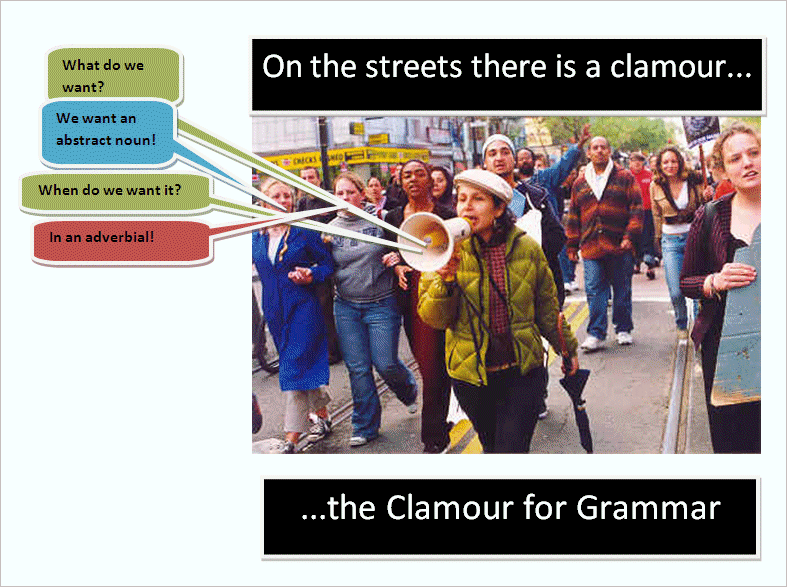
The Clamour for Grammar

Following on from our successful Glamour of Grammar day in July 2010, we are pleased to announce a second dubiously-titled day of grammar. The Clamour for Grammar will take place on Wednesday 10th November at UCL. Presented by Bas Aarts and Dan Clayton, the day will start with a crash course on word classes, phrases and clauses before moving on to focus on practical approaches for using grammar to analyse texts.

The day is aimed at teachers of Key Stages 3 and 4, but would also be suitable for people new to teaching A level English Language. The practical approaches sessions will focus on the spoken word, language and literature, and we're hoping to provide a range of lesson resources that can be used straight away as introductory materials in the classroom.
The price for the full day (including lunch and refreshments during the day) will be £95.

For more details, email Dan Clayton through this link on the Survey of English Usage webpages.

The link to the most recently updated plan for the day is here.

What grammar shouldn't be about

Simon Heffer has a new book out and it's called Strictly English. It's a title that, with its twin whiffs of prescriptivism and punishment, calls to mind Lynne Truss's "zero tolerance approach to punctuation" which David Crystal so systematically debunked here.

Heffer sets himself up as an authority on language and then sets about telling us what's right or wrong in English grammar. In fact, he's on record as saying that "English grammar shouldn’t be a matter for debate". This is, for want of a better word, cobblers. One of the key aims of our project here at UCL is to investigate grammar, to open it up for debate and exploration, not to close it down into a set of rights and wrongs. Such a prescriptive view of language doesn't really help anyone.

Language Log have already laid into him here and here, and I've blogged about his appearance on Radio 4 here.

Tuesday, September 7, 2010

Verbing

The MacMillan Dictionary blog is always a good source of material on language and there's a recent piece on there by Jonathan Marks about the process of conversion (sometimes called verbing) when you change the word class of a word and use it in a new and original way.

Monday, September 6, 2010

New grammar day planned

We're planning to put on a second grammar day for teachers on Wednesday November 10th at the Department of English Language and Literature at UCL.

This time, we're hoping to focus very much on the basics of grammar and aim the day at teachers who either want to go right back to basics, or those that feel they need a refresher course. Therefore, this day is really for Key Stage 3 and 4 teachers, and those who are new to A level English Language.

There'll be more details on here and the project page next week.