Thanks very much to everyone who came to our Clamour For Grammar day on Wednesday. It was a small, specially-selected - some might say "elite" - group of teachers and advisers who came along for the day and we were really pleased to meet you. We've already had some very positive feedback and are thinking ahead to similar days next term and/or in the summer. If you are interested in coming along to another grammar day (Grammar Hammer, perhaps?) or have specific ideas for what you would like covering in future sessions, please let us know by emailing Dan on the address on this page. We're also interested to find out the best time of year to organise such days.
Thanks too to Seth Mehl for his help on the day.
Friday, November 12, 2010

Friday, November 5, 2010
Spreading the word
We've been trying to raise the profile of grammar teaching and the ideas involved in our project by talking to various other sites and publications, and you can see some of the fruits of that in the following links.
Interview with Ben Zimmer of Visual Thesaurus website: part one & part two. The discussion after the interviews is probably worth having a look at too.
Article in today's Times Educational Supplement by Dick Hudson and Dan Clayton and news story here. Supporting page with further links and reading can be found here.
Thanks to Ben Zimmer for the Visual Thesaurus coverage and Rita Ofori for her help with the TES article.
Interview with Ben Zimmer of Visual Thesaurus website: part one & part two. The discussion after the interviews is probably worth having a look at too.
Article in today's Times Educational Supplement by Dick Hudson and Dan Clayton and news story here. Supporting page with further links and reading can be found here.
Thanks to Ben Zimmer for the Visual Thesaurus coverage and Rita Ofori for her help with the TES article.
Tuesday, October 5, 2010
"Correcting" local dialect and slang
The history of grammar teaching has often been associated with prescriptive models in which the "correction" of perceived faults in language has been paramount. While linguists are careful these days to talk about what is "grammatical" or "ungrammatical" and "standard" or "non-standard", rather than what is "right" or "wrong", there is still a tension at the heart of the teaching of English.
Emma Thompson hinted at this when she was widely reported in the media last week as having criticised the language of young people at her old school (Camden School For Girls, incidentally one of the nine secondary schools we're working with on this project) for its supposed reliance on likes, innits and off ofs. While she was fairly careful to couch her criticisms in a liberal language of acceptance of slang in its context and awareness of the need for two languages, at the heart of her attack lies a prescriptive view that some forms of language are just bad and that they make the user of them look bad too.
The grammatical arguments about the terms she chose to pick up on are quite interesting. Innit has been studied in the last few years, and identified as an invariant tag question (a tag that doesn't change to agree with the subject of the statement it follows: so it's innit at the end of she's nice, I am pleased, we are going there and they are bad, etc.). Grammatically, it has become something new. You might - like Emma Thompson - dislike it, but it's got its uses and it is quite a powerful device. Another use, and probably a more recent one is as a response to its tag question form. So, younger speakers often employ it in a conversation to show agreement to it being used as an affective tag.
Also, with like we have a word that has often been used as a filler, but that has now become something else as well. In its quotative usage, we can see that it is used to perhaps dramatise and emphasise elements of reported/direct speech in storytelling. For example:
But it's not just slang that causes upset to a prescriptivist mindset: dialect is a threat too. In yesterday's Daily Mail, a short report told us that teaching assistants in Portsmouth (two of them - close to a national scandal) had been criticised by OFSTED for their use of local dialect. The example quoted in the story, "I likes football", sounds like a fairly typical example of south coast dialect to my ears.
Why is it a problem? Well, if you read the comments that follow the article (never a good idea if you're trying to stay balanced and the right side of happy on a dreary Monday morning) you'll see a splenetic outpouring of disgust. Teachers are illiterate! Tony B-Liar is to blame! Education, education, schmeducation! Country bumpkins shouldn't be allowed near our kids!
That's fairly typical for the Daily Mail's message boards, and among the vitriol and badly spelled attacks on immigrants and left-wing teachers who use street slang is an undercurrent of dismay that the grammar of Standard English is at risk. And here is the tension referred to earlier.
The common perception of regional dialects among many English speakers is that they belong to the lower social orders, that they are inferior forms, but the reality is that many of us use regional forms without being particularly conscious of them. Whether it's the Cockney we was or the Reading he done it, regional dialect is still alive and well, and it has a grammar of its own. The tension comes in establishing its place in relation the grammar of Standard English in the education system.
If one of the key aims of teaching Standard English is to establish a shared, mutually intelligible form of the language for everyone educated in the UK then does having a teaching assistant who uses a local dialect damage the educational opportunities of young people? Probably not. I think an argument that might be effective here is that if we properly study the grammar of both Standard English and regional varieties (and sociolects like slang varieties too) we will learn a great deal more about not just grammar as a system, but also about the history of the language, feelings we have for our own varieties of language and the connections we have to our own communities of practice and social backgrounds.
So, I think it should be argued that neither slang nor dialect should be seen as a threat to the education of young people, but as legitimate and rewarding areas of language study, both of which can help students enrich their understanding of language in all its varieties.
I'd be interested in any views from readers, so please post comments.
Emma Thompson hinted at this when she was widely reported in the media last week as having criticised the language of young people at her old school (Camden School For Girls, incidentally one of the nine secondary schools we're working with on this project) for its supposed reliance on likes, innits and off ofs. While she was fairly careful to couch her criticisms in a liberal language of acceptance of slang in its context and awareness of the need for two languages, at the heart of her attack lies a prescriptive view that some forms of language are just bad and that they make the user of them look bad too.
The grammatical arguments about the terms she chose to pick up on are quite interesting. Innit has been studied in the last few years, and identified as an invariant tag question (a tag that doesn't change to agree with the subject of the statement it follows: so it's innit at the end of she's nice, I am pleased, we are going there and they are bad, etc.). Grammatically, it has become something new. You might - like Emma Thompson - dislike it, but it's got its uses and it is quite a powerful device. Another use, and probably a more recent one is as a response to its tag question form. So, younger speakers often employ it in a conversation to show agreement to it being used as an affective tag.
Also, with like we have a word that has often been used as a filler, but that has now become something else as well. In its quotative usage, we can see that it is used to perhaps dramatise and emphasise elements of reported/direct speech in storytelling. For example:
I'm like, "You're not getting in. You weren't invited".Again, whether you like it or not, it's now got a new way of being used, reflecting the flexibility of our evolving language.
And she's like, "What you gonna do about it?".
But it's not just slang that causes upset to a prescriptivist mindset: dialect is a threat too. In yesterday's Daily Mail, a short report told us that teaching assistants in Portsmouth (two of them - close to a national scandal) had been criticised by OFSTED for their use of local dialect. The example quoted in the story, "I likes football", sounds like a fairly typical example of south coast dialect to my ears.
Why is it a problem? Well, if you read the comments that follow the article (never a good idea if you're trying to stay balanced and the right side of happy on a dreary Monday morning) you'll see a splenetic outpouring of disgust. Teachers are illiterate! Tony B-Liar is to blame! Education, education, schmeducation! Country bumpkins shouldn't be allowed near our kids!
That's fairly typical for the Daily Mail's message boards, and among the vitriol and badly spelled attacks on immigrants and left-wing teachers who use street slang is an undercurrent of dismay that the grammar of Standard English is at risk. And here is the tension referred to earlier.
The common perception of regional dialects among many English speakers is that they belong to the lower social orders, that they are inferior forms, but the reality is that many of us use regional forms without being particularly conscious of them. Whether it's the Cockney we was or the Reading he done it, regional dialect is still alive and well, and it has a grammar of its own. The tension comes in establishing its place in relation the grammar of Standard English in the education system.
If one of the key aims of teaching Standard English is to establish a shared, mutually intelligible form of the language for everyone educated in the UK then does having a teaching assistant who uses a local dialect damage the educational opportunities of young people? Probably not. I think an argument that might be effective here is that if we properly study the grammar of both Standard English and regional varieties (and sociolects like slang varieties too) we will learn a great deal more about not just grammar as a system, but also about the history of the language, feelings we have for our own varieties of language and the connections we have to our own communities of practice and social backgrounds.
So, I think it should be argued that neither slang nor dialect should be seen as a threat to the education of young people, but as legitimate and rewarding areas of language study, both of which can help students enrich their understanding of language in all its varieties.
I'd be interested in any views from readers, so please post comments.
Thursday, September 16, 2010
Verbs and adverbs
And while I'm plugging Visual Thesaurus (and using coordinating conjunctions to start my sentences, just to spite Simon Heffer and his chums), here's a link to a good article about teaching descriptive writing strategies. We're often told that good writing should be descriptive, but that good writers shouldn't automatically reach for an adverb to a modify a verb, when a well-chosen verb will work better, but here are some really good ideas for making that advice a bit more practical.
Grammar and vocabulary extension
Morphology - the study of the form of words - is an area of grammar that sometimes gets forgotten. This brief article on the Visual Thesaurus site talks about using morphology to help students develop their understanding of words with similar morphemes. In this case, the examples are the Greek roots -crat and -cracy.
Wednesday, September 15, 2010
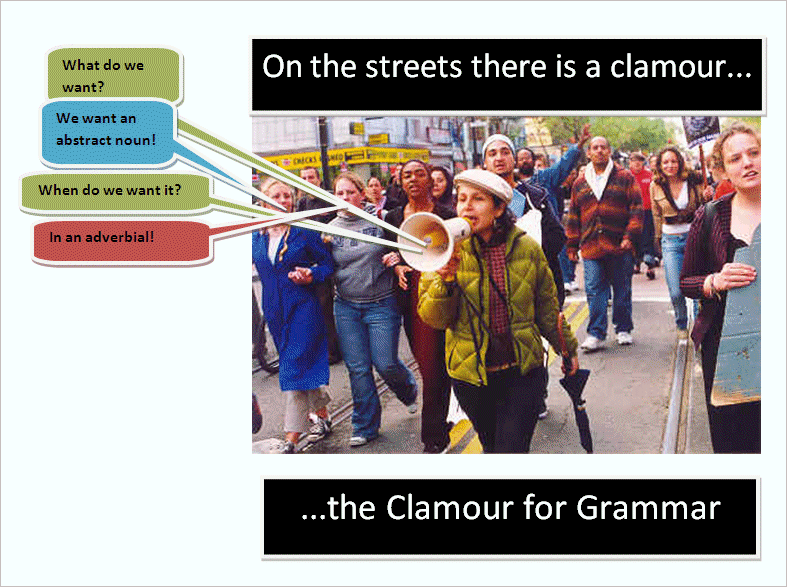
The Clamour for Grammar
Following on from our successful Glamour of Grammar day in July 2010, we are pleased to announce a second dubiously-titled day of grammar. The Clamour for Grammar will take place on Wednesday 10th November at UCL. Presented by Bas Aarts and Dan Clayton, the day will start with a crash course on word classes, phrases and clauses before moving on to focus on practical approaches for using grammar to analyse texts.
The day is aimed at teachers of Key Stages 3 and 4, but would also be suitable for people new to teaching A level English Language. The practical approaches sessions will focus on the spoken word, language and literature, and we're hoping to provide a range of lesson resources that can be used straight away as introductory materials in the classroom.
 The price for the full day (including lunch and refreshments during the day) will be £95.
For more details, email Dan Clayton through this link on the Survey of English Usage webpages.
The day is aimed at teachers of Key Stages 3 and 4, but would also be suitable for people new to teaching A level English Language. The practical approaches sessions will focus on the spoken word, language and literature, and we're hoping to provide a range of lesson resources that can be used straight away as introductory materials in the classroom.
For more details, email Dan Clayton through this link on the Survey of English Usage webpages.
The link to the most recently updated plan for the day is here.
What grammar shouldn't be about
Simon Heffer has a new book out and it's called Strictly English. It's a title that, with its twin whiffs of prescriptivism and punishment, calls to mind Lynne Truss's "zero tolerance approach to punctuation" which David Crystal so systematically debunked here.
Heffer sets himself up as an authority on language and then sets about telling us what's right or wrong in English grammar. In fact, he's on record as saying that "English grammar shouldn’t be a matter for debate". This is, for want of a better word, cobblers. One of the key aims of our project here at UCL is to investigate grammar, to open it up for debate and exploration, not to close it down into a set of rights and wrongs. Such a prescriptive view of language doesn't really help anyone.
Language Log have already laid into him here and here, and I've blogged about his appearance on Radio 4 here.
Heffer sets himself up as an authority on language and then sets about telling us what's right or wrong in English grammar. In fact, he's on record as saying that "English grammar shouldn’t be a matter for debate". This is, for want of a better word, cobblers. One of the key aims of our project here at UCL is to investigate grammar, to open it up for debate and exploration, not to close it down into a set of rights and wrongs. Such a prescriptive view of language doesn't really help anyone.
Language Log have already laid into him here and here, and I've blogged about his appearance on Radio 4 here.
Subscribe to:
Posts (Atom)
